The third episode of the New Byte podcast featured a rich, insight-filled conversation with the founders of Achei Gramado, Erones and Saviani, two entrepreneurs who today manage nearly 300 short-term rental properties, including a franchise model expanding along the Santa Catarina coast.
If you're a professional host, property manager, or considering entering this market, this content is for you.
Watch the full episode on YouTube:
From Extra Income to Nearly 300 Properties: The Achei Gramado Story
Achei Gramado started the way many entrepreneurship stories begin, with a conversation on an ordinary afternoon about how to generate extra income. Erones and Saviani lived in Gramado, had other jobs, and spotted an opportunity right at their doorstep: the short-term rental market in the Serra Gaúcha region.
The initial idea was simple: sublet properties on a temporary basis and charge a commission. But the plan to "keep it small" didn't last long. As Erones himself told it during the episode, those with an entrepreneurial spirit can't close the door on opportunities.
Gramado as the Ideal Setting for Short-Term Rentals
Living in Gramado is, in itself, an immersion in tourism. The high demand for accommodation in the region, especially during events like Natal Luz and Gramado Summit, creates a fertile environment for short-term rentals. Even local residents face difficulty with annual leases, since many property owners prefer renting short-term at higher rates. It was precisely this scenario that sparked the creation of Achei.
Another factor that made a difference was Saviani's prior experience as a partner in a hostel. He was already familiar with management software, channel managers, and the dynamics of hospitality, he just lacked knowledge of the short stay universe. This background, combined with the discerning profile of the tourist visiting Gramado, helped the company build a quality-focused operation from day one.
Owner Payouts: Before and After Automation
One of the central topics of the episode was the owner payout system, a genuine pain point that virtually every professional host is familiar with.
Before: Spreadsheets, Manual Pix, and Days of Work
Before using New Byte's payout system, Saviani described the routine as a true operational nightmare. The process of paying out property owners took two to three full days, from the moment they woke up to the moment they went to sleep, making Pix transfers one by one on a phone, double-checking amounts, cross-referencing information in spreadsheets, and focused on avoiding duplicate payments.
"You start dealing with significant amounts that belong to other people, and there's real responsibility behind that," Saviani adds, noting that "at the time, there was the additional challenge of convincing property owners to adopt Pix, which had only recently launched."
After: Automation With Tax Security
Achei Gramado was one of the first clients to use New Byte's automated payout system. The change was radical: what used to take days was now done in minutes, with financial and tax security, automatic invoice generation, and full legal compliance. This freed up time and energy to focus on what truly matters: the operation's growth.
This is a point worth reinforcing: when you work with third-party properties, trust in the financial side is decisive. Property owners want to see professionalism in payouts, communication, and transparency, and that's exactly what automation delivers.
Dynamic Pricing: From Gut Feeling to Algorithm
Another topic that sparked great discussion was the pricing of short-term rental properties.
At the start, as happens with most hosts, pricing was based on gut feeling: browsing listing by listing, looking at competitors' prices, and trying to keep up. The problem is that this approach only works up to a point. When the portfolio grows, it's humanly impossible to monitor price fluctuations in the market 12 months ahead across dozens of properties, Erones and Saviani noted.
The turning point came with dynamic pricing software, which works similarly to airline tickets: adjusting rates daily, tracking real-time market demand. "That was when we realized the system was suggesting a price we wouldn't have had the nerve to charge ourselves," Saviani recounted. "And it works. People pay it."
The Lesson Is Clear
Trust the technology, but don't abandon strategy. The algorithm doesn't run by itself, it needs your vision of gaps between bookings, stay duration, seasonality, and local event mapping.
Demand Peaks and Floods: Handling the Unexpected
The episode also included an account of how the 2024 Rio Grande do Sul floods impacted Achei Gramado's operation, and what came afterward.
In 48 hours, the company lost 48% of its bookings to cancellations. The airport recovery took time, the economic impact was severe, and all growth projections had to be revised. But then came the turnaround: when Gramado reopened, demand exploded, and local tourism infrastructure was not ready for that surge.
This scenario is more common than it seems in the short stay market. Demand spikes, whether from events, holidays, or atypical situations, are extremely challenging because they compress turnaround time between bookings and create enormous operational strain on staff, linens, and physical structures.
AI in Guest Service: The Silent Revolution in Operations
Perhaps the most exciting part of the episode was about how artificial intelligence transformed Achei Gramado's operation.
From 150 to 220 Properties With the Same Service Team
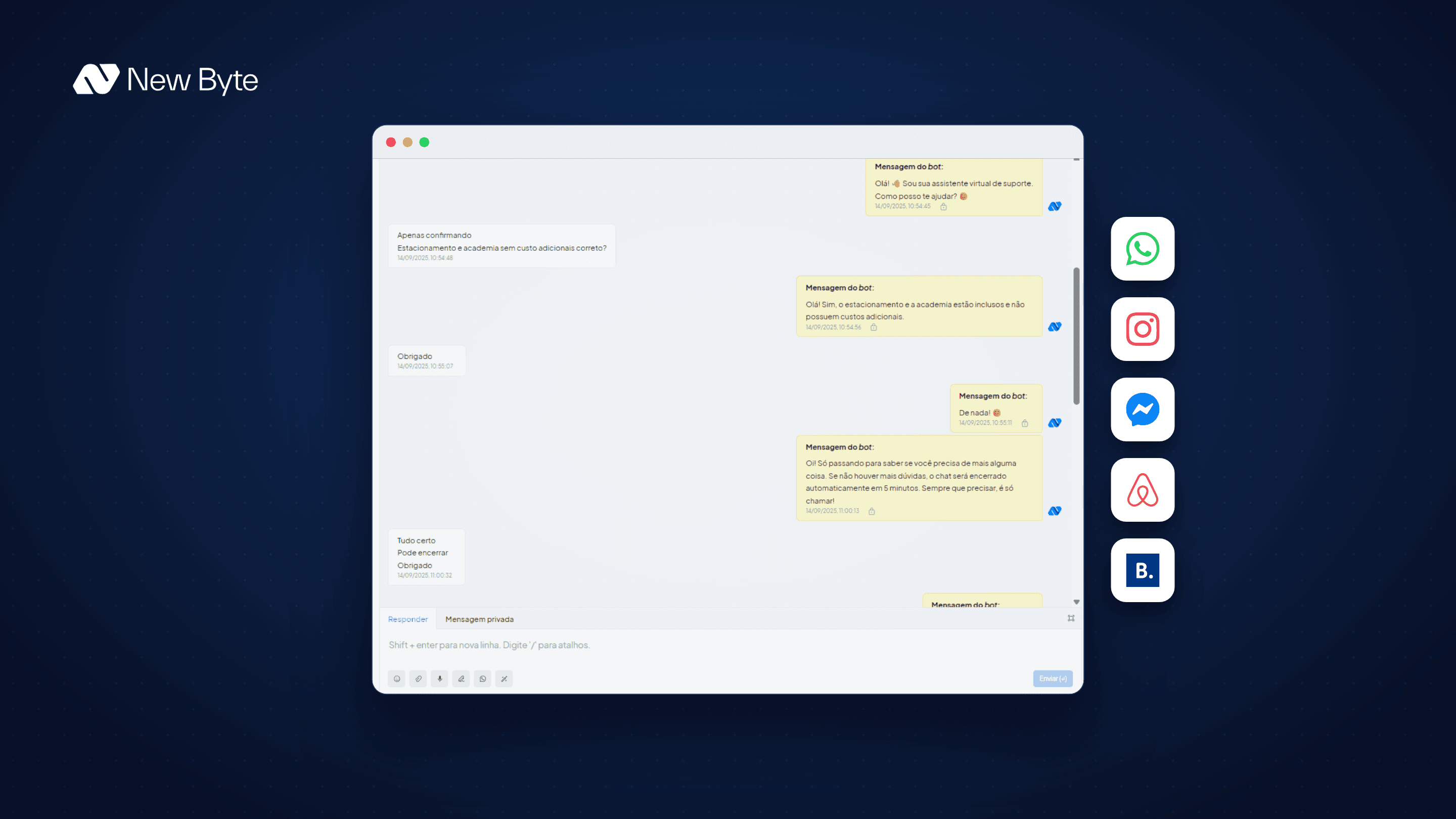
In the last season, the company grew its portfolio by 70 properties, from 150 to nearly 220, while keeping the same number of people in the service department. This was only possible thanks to New Byte's AI, which started automatically answering repetitive questions and serving guests 24 hours a day, including the overnight shift. To give an idea: "does the apartment have a hair dryer?" was answered more than fifteen times a day by the team, today, Nia, New Byte's service AI, handles that work.
The Team Learned From the AI
A noteworthy detail was that the service agents began learning from how the AI responded. The AI's fast, complete, and empathetic answers served as a model for the team, which started adopting certain phrases and approaches in their own human service. "They started learning from the AI, adopting certain expressions and ways of approaching conversations," Erones recounted.
Operational Insights From Service Conversations
Another benefit that came with AI was the ability to generate operational insights. By analyzing the thousands of conversations exchanged over the year, the platform identifies patterns and bottlenecks, such as recurring maintenance issues at certain properties, cleaning failures, or questions that could be resolved with better upfront communication. This enables proactive management rather than purely reactive responses.
Short-Term Rental Franchises: The Achei Gramado Model
Achei Gramado has been operating a franchise model for about two years, with units in Balneário Camboriú, Florianópolis, and Itapema. And the model reflects exactly what the company built over the years: mapped processes, technology implemented at the right time, and quality-focused growth.
Every Phase Has Its Moment
One point that came through clearly in the episode is that not every technology makes sense from day one. "Pretty soon you're not going to implement a chatbot with a bunch of unnecessary processes to service three properties," Saviani explained. The logic is to guide the franchisee phase by phase: up to 15 or 20 properties, the operation works one way; after that, new processes and tools come into play.
Each Destination's Quirks
Every region has its particularities. In Camboriú, for example, the issue of towels stained by sunscreen requires a specific fabric type that isn't needed in Gramado. Item availability also varies: in Gramado, given its family-oriented tourism profile, Achei provides foldable travel cribs in all properties; in Camboriú, it's up to the property owner. These operational details make a real difference in service quality, carefully planned and structured for the target audience of each city.
Tips for Those Who Want to Grow in the Short-Term Rental Market
To close the episode, Erones and Saviani left valuable advice for those starting out or wanting to scale their operation.
Professionalize From the Start
If the goal is to have a robust portfolio, 100, 150, 200 properties, professionalization needs to come from the beginning. Structured growth prevents unnecessary overload and ensures consistent quality delivery. Automate everything that can be automated and direct your personal effort toward what truly requires human attention.
Select Your Properties With Criteria
Not every property is worth it. Properties with recurring structural problems or difficult owner clients will consume more energy than the financial return they generate. "Sometimes you also have to fire the client," said Saviani. That energy could be directed toward clients with much greater potential.
Cut Corners, Don't Create Bureaucracy
Achei Gramado's mindset is to trim as much as possible, from the chatbot flow to the entire operation. Before creating a new process, the question is always: "is this really necessary?" If it doesn't make sense, they cut it. This philosophy is reflected in everything, from guest service to internal management.
Stay Grounded
Finally, a piece of advice that sounds simple but is hard to follow: don't let ego speak louder. A more robust structure driven by vanity can eat into the profit that would make a real difference in the quality of service delivered to the end customer.
The Short Stay Market in Brazil Is a Blue Ocean
Erones closed the episode with a reflection worth highlighting: with nearly 200 properties in the Serra Gaúcha, Achei Gramado is the largest short-term rental manager in the region. And 200 properties, in many places, would fit inside a single condominium building. "I believe that here in Brazil we are at the very beginning of short stay. There is so much still to be done."
The short-term rental market is being professionalized right now, by companies like Achei Gramado and New Byte. Those who enter with well-defined processes, the right technology, and a focus on quality have enormous space to grow.