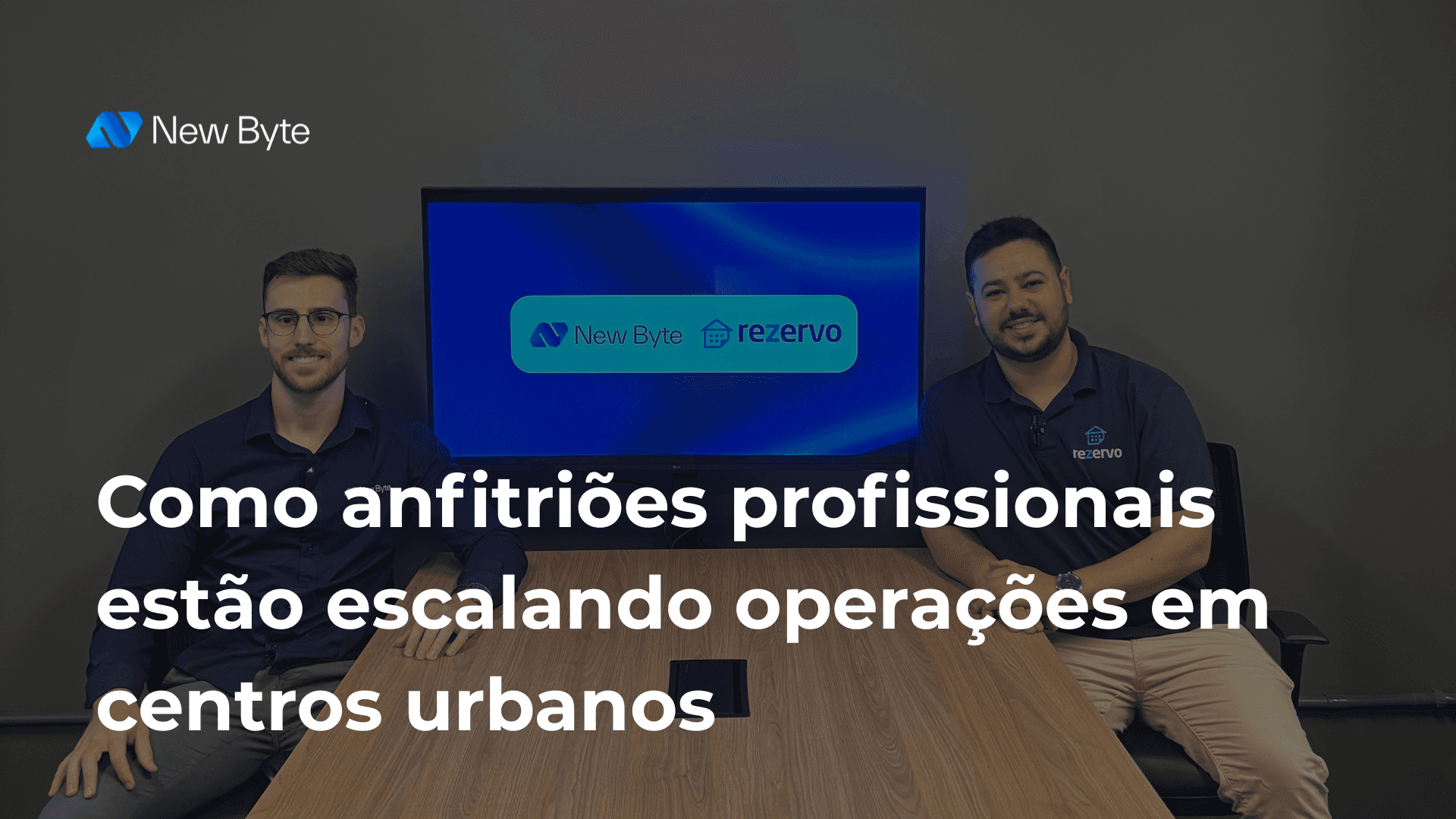
In the second episode of the New Byte Podcast, Johnny Santana from Pleeh joined us to discuss the growth of the short stay market and the impact of professionalization in short-term rentals.
What Is the Short Stay Market Like in Brazil?
When you're looking for a place to stay during a trip, you're more likely to search on Airbnb or Booking than to look for a hotel. The short-term rental market in Brazil offers endless possibilities, from a loft for a business trip, to a house by the beach for a few days, or an apartment closer to a hospital for a medical treatment.
This is a sector that grew and expanded very quickly, yet only a small portion of it has professionalized and prepared for that scale.
"Less than 5% of people are doing truly professional management," Johnny comments on the market's evolution.
What happens in the sector is that many people entered the short stay market in Brazil looking for extra income, and few start in a structured way. As a consequence, this generates a lack of standards and processes, as well as an absence of financial vision when faced with growth.
Why Do Short-Term Rental Operations Fail?
When it comes to property management, you can't fall into the "back-of-the-envelope calculation" trap, as was highlighted during the second episode of the New Byte Podcast. There's an illusion around the 20% commission, where a host who hasn't prepared for the market ends up forgetting costs such as taxes, cleaning crew, rework, and some losses that can happen when something breaks in the property.
Many hosts earn a good financial return but don't actually know what their real profit is. The absence of a business mindset, combined with a lack of financial planning, leads to disorganization of the entire operation. However, there is a solution to this problem.
What Is the Difference Between a Professional Host and an Amateur?
The great dividing line in the short-term rental market in Brazil is the business mindset, as we've already highlighted. Given that many people start as a side income, if there's already difficulty when managing ten properties, imagine managing guests across a hundred properties or more.
"The decision to invest in technology came when service started eating into our profit margin," Johnny emphasizes.
While the amateur tries to handle everything alone, using spreadsheets and keeping conversations centered on individual agents, the professional host seeks to structure the process through technology.
Technology and Automation to Scale in the Short Stay Market
If service becomes the operational bottleneck, you need to find a solution that centralizes property information, reducing human errors and preventing overbooking.
The WhatsApp Strategy as an Operational Channel
In guest service, WhatsApp automation makes all the difference, from time savings to the standardization of the guest experience. It can be done with chatbots, where there's a simple process for initial filtering of the customer's problem or question. Beyond that, there is the use of artificial intelligence in service. In this case, the AI converses with the guest, queries the database, answers questions, and only transfers the guest to a human agent when the information is not in its database.
Is Technology Too Expensive for Short-Term Rentals?
It depends on what you consider an investment cost. For example, think about the cost of an unprepared team of agents, with multiple customers lost due to slow responses or a lack of clarity when informing them about the property. Additionally, consider the loss from centralizing service in one person who could eventually resign, and all of that knowledge is lost to the company. This doesn't happen when technology is integrated with processes and a scaling strategy.
Being Professional in the Short Stay Market Is a Choice
Compared to markets at a higher level of maturity, such as those in North America and Europe, Brazil has enormous growth potential. As technology becomes a tool in the hands of professional hosts, expansion becomes more structured and profits scale. This makes it possible to opt for smaller teams and a greater focus on business expansion, in addition to automating other parts of the process, such as owner payouts and automatic document collection.
This combination of factors helps differentiate from the competition, with plenty of room to stand out. While the competition focuses on solving isolated problems, your company sustains long-term growth.