Have you ever thought about where your operation's knowledge lives? In a spreadsheet, an internal database, or in the memory of your team members? And beyond that, what is your service standard? Do you use any automation or do you depend on whenever you have time to respond?
What if I told you that all of these things are easy to fix with a single tool, an AI that does much more than answer: it learns with every service interaction.
What Is NLearn from New Byte?
NLearn is another tool in New Byte's AI-powered service ecosystem. The AI connects to a channel manager and a customizable database with information about the host's properties and company, delivering standardized service and responding as if it were a human agent.
When a guest asks something that isn't in the database, the conversation is directed to a human agent. That's where NLearn comes in. The tool analyzes the information the agent responds with and captures that knowledge, transforming the previously unanswered question into reusable responses for guests, after the host's approval, of course.
Why Is NLearn Different From a Standard Knowledge Base?
In traditional knowledge bases, someone has to stop and write an answer for the guest, perform the manual update, and also risk disorganizing the operation's information structure.
The key differentiator is that NLearn learns from the natural flow of service, using real situations to constantly evolve. Where the same problem used to repeat itself, NLearn now delivers the solution quickly. All new information is added to the knowledge base as it emerges.
This creates an intelligence flow that continuously improves itself.
How Does NLearn Work in Practice?
Imagine that when filling in the AI's knowledge base, you forget to include information about how to access the building's gym. In that case, the guest asks, the AI doesn't know, and the human agent responds. The next time, this won't happen, because the system learns. At another point, a new guest will ask the same question, and the AI will provide the answer that was documented and automated through NLearn.
What Is NLearn's Pipeline?
The flow is simple: the conversation happens, the AI analyzes it, the human reviews it, and then the content is published. There will always be an approval checkpoint, nothing is published automatically or without the professional host's review.
Within this flow, there are three levels of information: public access, booked, and in-house.
Public access information includes, for example, nearby establishments such as bakeries and restaurants. The booked category refers to information available after scheduling and payment of a stay, such as the check-in address. And in-house refers to private information specific to that property, such as Wi-Fi passwords and the location of items inside the apartment like safes.
How Is the Response Structured?
The system identifies when service is handed off to a human, and shortly after the interaction is complete, NLearn analyzes the agent's response and generates a suggested improvement, identifying what is truly relevant and deciding whether it's worth adding this knowledge to the database. Importantly, the tool also reviews typos, spelling, and grammar in the information provided.
When proposing the response, it is already structured, ensuring fidelity to what was said, clarity, and zero fabricated information.
NDocs Publication
Once the response is approved by the human, the content enters the official database and the AI starts responding on its own.
System Maturity: What It Learns and What It Rejects
NLearn is a tool that improves based on questions and information, from pool access hours to nearby establishments, check-in details, property rules, and instructions for using household items.
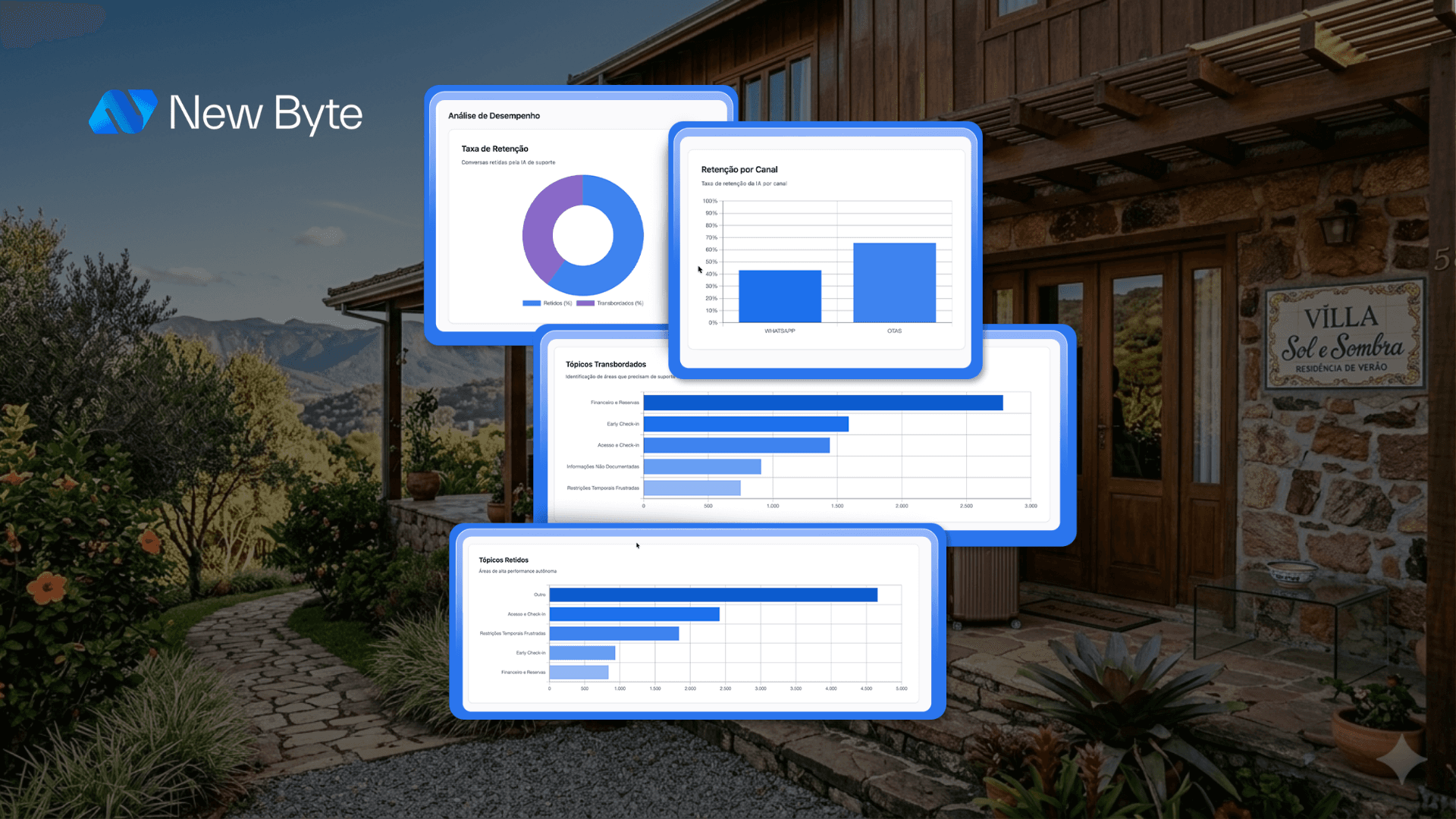
What it doesn't use to generate direct knowledge, so-called "non-learnable" information, typically includes complaints about the property, maintenance requests, negotiations, or exception requests, which are handled through human service. If the host is interested in this guest feedback, they can access Insights and get data analysis, as well as measurement of human service efficiency. With this tool, the host can visualize what is creating bottlenecks in their short-term rental operation.
What Else Does NLearn Do?
Even in situations where the tool won't generate public content for the guest, it also generates Insights. NLearn will identify operational problems, map guest sentiments regarding how service was conducted, and classify their urgency. This information is retained in Insights, available on New Byte's Elite Plan.
The importance of this is to provide the professional host with better property management, supporting decision-making through a real data foundation. This provides a clear view of what drives the most contact and results.
Operational Impact
Day to day, the host will notice a reduction in repetitive service requests, AI improvement over learning time, and less dependence on people. Many of these solutions are already present in New Byte's service tools, NLearn comes to further strengthen the scaling process without compromising operation quality.
Continuous Learning Transforms Short-Term Rentals
Human service doesn't need to be just support, it can be a source of knowledge. NLearn is the tool that transforms your operation into intelligence: an AI that learns every day from those who understand your business best.
What Are NLearn's Results for Operations?
- Fewer repeated tickets, greater AI self-service.
- Retained knowledge, with no losses from staff turnover.
- Scale without additional cost.
- Knowledge base always updated with real problems.
- Zero curation effort.
Get in Touch With New Byte
Talk to our specialists and request a demo of NChat, NLearn, and NLytics!