When a guest sends the first message, how much work is there until the money lands in the owner's account?
The question is not how many days. It is how many tasks.
The answer is twelve. Twelve different processes, with different owners, in different tools, repeated with every booking. Anyone running vacation rentals does all of them, even without ever stopping to count.
We have already covered the main pains of professional hosts. This post does something else: it lays out the operation in the order it actually happens, from the inquiry to the payout. At the end, the question that matters: how many of these steps are still done by hand.
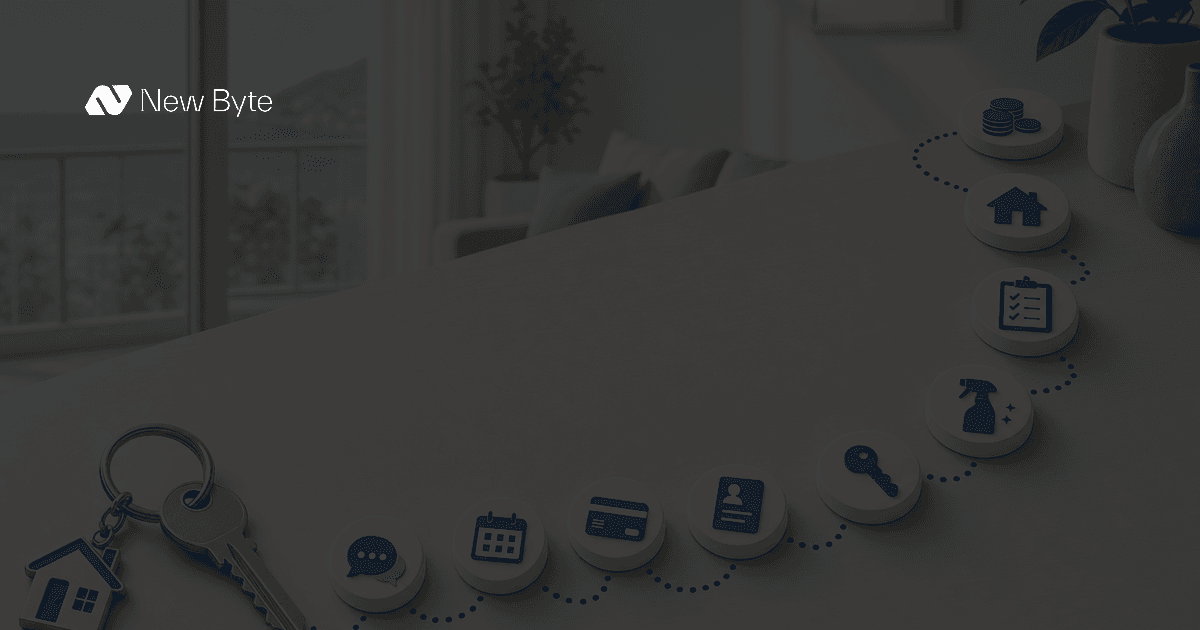
The 12 steps, in booking order
Before the booking
01. Answer the Airbnb inquiry and the WhatsApp quote. The same question about dates, price and availability, all day long, from different people. A good share arrives outside business hours, and whoever answers first usually gets the booking. Centralizing these channels is the first step.
Closing
02. Charge the direct booking. You closed outside the OTA, saved the commission and gained a new task: generating the payment link, booking by booking.
03. Confirm the payment. Open the bank statement, find the receipt in the middle of the chat, mark the booking as paid and remember to tell the guest.
Pre-arrival
04. Collect documents and send them to the building's front desk. Ask by message, save the photo and send it the way that building accepts. One building wants an app, another wants email, another wants it printed. It is one of the steps that most often stalls the operation, and we have already shown how to simplify document collection.
05. Sell early check-in, experiences and amenities. The step almost nobody does. It turns into a courtesy because charging is a hassle, and the guest who was willing to pay gets it for free.
Arrival
06. Send the arrival instructions. Address, door code, Wi-Fi, where the parking spot is. Copied from the last chat, pasted and adapted, and every agent sends it differently.
07. Grant access and change the smart lock code. Changing the code between one guest and the next, when someone remembers. When nobody remembers, the guest from three months ago can still get in.
During the stay
08. Answer guests with questions or problems. The step that has no schedule. It comes through WhatsApp, Instagram and the OTA chat, and it is the one that takes up the most people.
Check-out
09. Sell late check-out. The same story as step 05, at the other end of the stay, with one advantage: here you already know who is in the property and whether the next guest arrives the same day. The cleaning would happen anyway. It is money already on the table.
After the stay
10. Collect the review and build a relationship on WhatsApp. Reviews hold up your ranking, and without asking, the guest most motivated to review is the one who left unhappy. The WhatsApp contact is what brings the guest back directly next time, without going through the OTA.
11. Notify cleaning and inspection. Tell the team before they hit the road. Getting this wrong costs a wasted trip, or the next guest waiting at the door.
Month-end close
12. Pay the owners and issue the invoices. Calculate, transfer one by one, check bank details and issue an invoice per property. Depending on the size of the portfolio, the close takes days, sometimes weeks. That is the subject of our post on payouts and invoices.
Now look at it all together
Inquiry and quote. Charging. Payment confirmation. Documents and front desk. Early check-in. Arrival instructions. Access. Questions and problems. Late check-out. Review. Cleaning. Payout and invoice.
That is one booking. One. Now multiply it by last month's bookings.
What it costs to grow without changing the process
The Noctua Survey, presented at STR Summit 2026, measured how many people vacation rental operations employ. In operations with up to 50 properties, the average is one person for every 5 properties. In operations with more than 250 properties, one person handles 33.
Do the math with your own portfolio. At one person per 5 properties, reaching 250 takes 50 people. The operations already at that size run with about 8 people, one for every 33 properties.
The difference between 5 and 33 properties per person is not the size of the operation. It is the process.
The problem was never lack of effort
People who work in vacation rentals work hard. The problem is that these are twelve processes nobody designed together. Each one was solved however it could be, whenever it got tight: one on WhatsApp, another in a spreadsheet, another in the building's app.
That is why hiring more people does not fix it on its own. Every new person inherits the same twelve patches. It is also what separates an amateur operation from a professional one: not the number of properties, the design of the process.
What New Byte does
New Byte exists to run these twelve steps. During onboarding, our team connects the platform to your channel manager, such as Stays, Ayrton or Guesty. From there, it answers the guest, charges, collects documents, notifies the front desk, notifies the cleaning team and handles the payout, within the rules you set.
Each step has a module responsible for it:
| Steps | Module | What it does |
|---|---|---|
| 01 and 08 | Nia | Answers inquiries, quotes and guest questions, 24 hours a day |
| 02, 03 and 12 | Owner payouts | Generates the payment link, records it on the booking and processes payouts and invoices from Stays |
| 04 and 07 | Document collection | Collects documents, sends them to the front desk and integrates smart locks via Magikey |
| 05, 06, 09, 10 and 11 | Automated notifications | Sends arrival instructions, late check-out offers, extra fee charges, review requests and cleaning alerts |
| All | NChat | The hub where conversations from every channel come together |
What runs on its own, and what stays with you
Automation does not take you out of the process. It takes you out of the part that repeats.
Runs on its own: the answer that repeats, the alert at the right time, charging and reconciliation, the document going to the front desk.
Goes through you: the offer before it becomes a charge, the complaint and the exception, the negotiation outside the rule, and what the AI learns from conversations before it starts using it.
One step per video
You already do all twelve. The question is how many are still done by hand.
This post goes with the first video of a series on YouTube. In the next ones, each step gets its own video: what breaks, what it costs and how to fix it.
Watch the full video and follow the series on the New Byte YouTube channel. If you want to see how the twelve steps run in your operation, talk to our team.